Monday, April 9, 2012

MENTAL HEALTH IN GHANA ( Editorial)


Anyone who breaks their arm should be locked up in a government facility, and the key forever thrown away.
If that sounds disturbing, good. It is. Just like a mental health care system that only institutionalises ill people or, worse, chains them up in illegal prayer camps, is disturbing.
It would be hard for anyone in 21st century to argue that “just dumping people”, to use psychiatrist Kwaw Armah-Arloo’s words, with mental illness a psychiatric hospital or – worse – in one of the prayer camps that rob so-called “mad” or “possessed” people of their fundamental human rights and dignity is preferable to helping them manage their conditions.
With the right support, people with all sorts of mental health issues can live full and productive lives in the bosom of their families and communities.
That is why the passage of the Mental Health Bill into law eight years after it was first tabled in parliament is nothing but a good thing.
Little wonder the champagne corks went flying as those who had been agitating for reform for year heard Michael Quay announced the passage of the Mental Health Bill in parliament four weeks ago.
Hurrah!
However, the shift in emphasis from institutional to community mental health care will, inevitably, throw up new and unforeseen challenges. That happens whenever, wherever, new laws are passed and new institutions and bureaucracies created.
The trick, as they say, will be the way these challenges are dealt with. As with almost every other facet of human interaction, the key to dealing with these effectively, with compassion and understanding for all affected, is education.

To emphasise; the key to the effective implementation of the Mental Health Bill is education. Education, education, education.
That is why it was so heartening to see scores of people take to the streets, in a long march from Ankaful to town (CHECK), celebrating the passage of the bill and challenging common misconceptions about mental health, on Tuesday, March 20.
“Mental illness: it could happen to U”, “stop stigmatizing people with mental health problems”, “stop human right abuse”, “send the mentally ill to hospital” and “seek early treatment” were just some of the messages the marchers brandished on placards.
This demonstration of celebration and education was no accident. A spontaneous outpouring of emotion by those at the frontline of mental health care provision lauding the passage of the bill it was not. Rather, it was part of a concerted effort, or action plan, drawn up by the architects of the bill.
Speaking just days after the bill passed on March 6, Ankaful Psychiatric Hospital Medical Director Dr Armah-Arloo, a key figure in establishing the new mental health framework, said while they awaited the formality of presidential assent to the bill and the funding to be in place, the work on education would begin immediately.
The education campaign would be three-pronged and ongoing. Dr Armah-Arloo and his colleagues have identified three target groups to receive tailored education: mental health care workers; the general public and key stakeholder groups, like the police.
“We are starting the education campaign with our own people, our own personnel. Then the second stage is when we educate the general public; and the third is where we are going to pick certain stakeholder groups, like the police, schools, church groups, and tailor the education to match where they feed into the legislation,” he said.
Perhaps one of the biggest challenges will be changing some of the more archaic cultural beliefs surrounding mental illness still prevalent in many parts of the country.
In addition, it is not simply relatively uneducated people living in rural and remote communities who need their preconceptions challenged.
In another win for mental health campaigners in Ghana last month, it was ruled that people with known mental illness should not be excluded from the biometric voter registration going on throughout the nation in the run-up to December’s election.
In an article on Ghana Web, mental health NGO Basic Needs lauded this decision. However, the article attracted comments from online readers, three out of five of which were quite negative.
For example, one commenter going by the online moniker deEvans wrote: “I thought a provision of the 1992 constitution says that the voter-eligibility criteria is: citizens of 18yrs and above and who are of SOUND MIND. Alternatively, has there been an amendment to that provision?  Someone should please educate me!”
That these comments, though anonymous, are made by literate, and supposedly educated, who care enough to post their thoughts online is quite shocking.
A person with bipolar disorder is not a person of unsound mind, far from it. With the right medication, their massive swings from mania to depression can be kept in check. It is quite possible to work with someone, even in the professions, and never realise they have a problem.
To disenfranchise them because of their condition is abhorrent.
It would be akin to taking the vote away from all those who previously, currently, or perhaps sometime in the future might, break their arms. Even if people with bipolar were insane, which they are not, they are still human beings and stakeholders in the community. As Ghanaians over the age of 18 they have every right to have their say at the ballot box. Bipolar disorder does not exempt someone from paying taxes.
With only three dedicated psychiatric hospitals in Ghana, and all of them situated in the south of the country, authorities can hardly act with surprise that so many people seek help for loved ones afflicted by mental illness from traditional healers and prayer camps.
As part of its educational campaign, the work of the soon-to-be Mental Health Board should ensure that those likely to encounter people suffering with mental illness, such as police, teachers and church leaders, handle them sensitively and get them the treatment they need.
In fact, that is why the establishment of a new breed of mental health professional, the community mental health officer, is so important. They will be the liaison between patients, their families, and key officials in their communities, so that all those involved in managing people with mental health issues know what they need to know about it.
Dr Armah-Arloo and his colleagues are only too aware of the problems of cultural attitudes and misconceptions in the effective, humane, and legal, treatment of people with mental health disorders.
He said health authorities would rather work with the prayer camps to change them than go after them with the full weight of the law. Health authorities wanted to educate prayer camp leaders about human rights and the new legislation and institutions that they must refer any person admitted to their care to.
“It will be a big job. Look at the number of prayer camps. In Central Region alone there are a lot – at least 10 or 12 of them,” he said.
If prayer camp leaders continued chaining up and otherwise maltreating people entrusted to their care, then, he said, they deserved to be arrested. Adapt or face prosecution is the message.
“First of all we are going educate them (camp leaders). First of all, they (the patients) have human rights. So we will tell the prayer camps ‘this is what you can do, this is what you can’t do and you have to do it in partnership with health services’.
“We will give them a grace period. If they continue chaining people, then you can prosecute it, as it is illegal to do this.”
Dr Armah-Arloo said it was an exciting time for mental health in Ghana – even if it meant he and his colleagues would not get much rest, especially during the next six months, as they got busy making all the provisions in the mental health bill a reality.
With such leadership and the right education, Ghana is well placed to make community-based mental health care a great success.
Many mental health issues in countries that have already undergone the transition to community-based mental health care are brought on as a result of the isolation and social dislocation people feel as part of Western consumerist cultures, where family and other social bonds are not always as strong as they once were.
So long as people are educated, these issues might yet be avoided in Ghana.
A British mental health care nurse, who is currently serving as a Projects Abroad volunteer, said the primacy of familiar bonds she has witnessed during her stay meant Ghana might avoid some of the problems with community-based care witnessed in the UK.
Writing as an obruni (I feel very akwaaba in Ghana – medase) native of Australia and resident in the UK, who has reported on health issues in both nations where the shift to community care has been made. While it is possible I may be romanticising the reality of life in Ghana, I am inclined to agree with my fellow volunteer.
However, prevailing social attitudes towards mental illness in Ghana must change.
Moreover, they will – provided the authorities get the education, education, education right.
Using last month’s March as a bellwether, the early signs are promising that this will be achieved.

Saturday, March 10, 2012

(ARCA 2012)


KNUST ALUMNI ASSOCIATION
1st APPLIED RESEARCH CONFERENCE IN AFRICA
(ARCA 2012)
29-31 AUGUST 2012
CALL FOR PAPERS

The Kwame Nkrumah University of Science and Technology (KNUST) Alumni Association of Cape Coast Polytechnic, in collaboration with the National Association,
is pleased to announce the Call for Papers for its First Research Conference. The aim of the APPLIED RESEARCH CONFERENCE IN AFRICA is to provide a platform for capacity building and networking among researchers in Africa.

THEME: THE SIGNIFICANCE OF RESEARCH AND DEVELOPMENT IN NATION BUILDINGVENUE: ELMINA BEACH RESORT


Papers relating but not limited to the following disciplines are welcome:

Engineering                    

 Built Environment   

Hospitality and Tourism            

 Food Science
 Oil, Gas and Energy       

 Medicine           

Statistical Modelling   

Information and Communication Technology
Applied Sciences & Arts    

Business        

Social Sciences                         

 Humanities

TIME TABLE
Submission of abstracts:                       20th April 2012                 
Notification of acceptance of abstract: 30th April 2012              
Submission of full paper:                     8th June 2012                
Refereeing decision:                            7th July 2012
Submission of revised paper:            31st July 2012

Conference:                                   29th -31st August 2012

Please email as attachment to knustalumni@gmail.com. Abstracts should not be more than 250 words and full paper not more than 10 pages.

 
Scientific Committee
Prof. W. O. Ellis, KNUST         

Prof. K. K. Adarkwa, KNUST   

 Prof. R. K. Nkum, KNUST       

 Prof I.K Dontwi, KNUST
Prof. E. Badu, KNUST        

Prof. G.W. K. Intsiful, KNUST 

  Dr. D. K. Ahadzi KNUST        

Prof. F. Acquah, UCC
Prof. H. S. Amonoo- Kuofi , UCC    

 Dr. M. Adom-Asamoah, KNUST    

Mr. E. Marfo- Yiadom, UCC       

 Dr. Alex Segbefia, KNUST
Prof. F. K. Forson, KNUST        

Prof. J. Ayarkwa, KNUST       

Prof. Awusabo Asare, UCC     

Dr. Assasie Oppong, KNUST
Prof. Nsiah Gyabaah, KNUST

Participation Information:
The conference registration fee is US$250 or its equivalence in Ghana cedis. The fee comprises the conference proceedings, lunch and visit to tourist sites in Elmina and Cape Coast.
The cost of accommodation ranges from US$40 to US$120 per night.
We are looking forward to receiving your abstract and seeing you at Elmina on 29th August 2012.
For further information, please contact: www. knustalumni.blogspot.com
Tel: 233-244-026432
Email: knustalumni@gmail.com

Monday, February 27, 2012

FIFA’S FOOTBALL FOR HOPE CENTRE KICK-STARTS IN CAPE COAST


Oguaa Football for Hope Centre
By Kirsty Telfer (Projects Abroad)

Despite the disappointing performance of the Black Stars at the recent Africa Cup of Nations, the youth of Ghana are still passionate about their love for football.
The Oguaa Football for Hope Centre in Cape Coast is paving the way for the stars of the future. Inspired by FIFA, who collaborated with Play Soccer International/Ghana to develop and build the facility, the centre uses football to reach out to the most destitute children to help aid their development and build on their skills for a positive future.
Play Soccer Ghana launched in 2001 as the Play Soccer International Network's first pilot program and has expanded from a single site with 100 children to 896 children currently registered at twelve sites in four regions across the country.
Building on the legacy of the 2010 FIFA World Cup in South Africa, FIFA promised to develop and help finance 20 football for hope centres in 15 countries in Africa, including 5 in South Africa. Working with non-government organisation (NGO) Play Soccer International, which is affiliated with Play Soccer organisations in 6 African countries, FIFA maintained they had a responsibility to aid development on the continent after the World Cup.
They therefore, along with grassroots organisations in the countries involved, set about building football-playing facilities to specifically benefit underprivileged children and those living in the most deprived communities.
Mr Abdul Wahab Musah (Manager, Oguaa Football for Hope Centre)
Mr Abdul Wahab Musah, Manager of the Oguaa Football for Hope Centre, who is also affiliated with Play Soccer Ghana, said sports development plays an essential role in assisting those children most in need of an education and gives the added benefit of playing football.
The centre runs on a 48-week curriculum and children aged 4-15 are invited to attend. The programme runs after school and every week a different skill is taught using football to engage, inspire and educate the children.
They are taught how to avoid malaria, are educated on the prevention of HIV/AIDS, issues regarding sanitation and hygiene and health related topics. Children are also taught essential leadership and social skills, which in turn helps to build self-confidence and a feeling of worth.
Mr Musah acknowledges the importance of an education alongside sport, and so the facility has a classroom where children do around 90 minutes of homework before playing football. He said the children are taught to understand that the career of a footballer is limited, and even those who make it to an international level need to have a profession and/or skill to use after their football career is over.
Play Soccer Ghana works in four regions, the Ashanti, Accra, Eastern Region and the Central Region.
Mr Musah said the success of Play Soccer Ghana was highlighted in the number of children who had turned up to register for the programme in the past. Previously limits had been placed on the number of children admitted due to a lack of funding.
He said it was estimated that over 500 children would turn up to register for the upcoming programme and he was confident that he would be able to accommodate everyone. Despite this, all children are means tested and interviewed before being offered a place on the programme. Having to decide which children do more deserve is by no means as easy task but has to be done due to such high demands.
One of the biggest challenges facing the children is transportation to the venue. Many children are willing to walk long distances to the centre, underlining the essential role the centre is playing in the lives of those children most in need.
The Oguaa Football for Hope Centre provides volunteer teachers to help children with homework before they play football. Other facilities at the centre include a computer lab, which is also open to high school students.
FIFA is sponsoring the centre for three years, with funding due to run out in 2013. They gave 50 percent of funds and the rest was provided by Play Soccer Ghana. Mr Musah said he believes this helps to sustain the programme and is confident that once the FIFA sponsorship ends, funds will be easily raised in and around the local communities.
However, he admitted that at the moment the Oguaa Football for Hope Centre receives no support from the government, although the Cape Coast district assembly is currently involved.
Another establishment run in conjunction with Play Soccer Ghana and at the Oguaa Football, for Hope Centre is Street Link; an organisation that targets adolescents aged 16-23.
Mr Musah said this is a vulnerable group most often neglected by society. He pointed out that Cape Coast has some of the best secondary schools in the country but current figures from the District Assembly show that it is a struggle to get even 30 percent of Cape Coast youth into good secondary schools.
Street League aims to get young people back into school or to provide them with essential skills to aid them in securing employment.
It works with young people who love football and who previously believed they could drop back from school in order to devote all their time to playing football.
Street League works with the young people to provide them with the opportunity to play football while also pursuing an education and/or a vocation.
Presently, 120 young people are involved in Street League, which runs on a 3-semester programme. The 1st semester is concerned with identifying the needs of those involved, and like the Oguaa Football for Hope programme; all participants are interviewed and needs tested. During the 2nd semester, external persons are invited to talk to the young people, educating them on life skills, development and opportunities for their future. Finally, the 3rd semester is concerned with getting the young people back into school or into a vocation/profession of their choice and skill level.
Mr Musah said the programme, currently in its seventh month, was so far proving to be very successful. Some young people have been trained as security guards, receptionists, and others have successful made the transition back to secondary school.
Street League’s football matches have boys and girls playing together and without a referee. In this respect, the players have to work together to decide when it’s a foul etc. and only when an argument is unresolved does an external person step in to help.
A football team from the Cape Coast School for the Deaf play with those from Street League. This in turn helps to promote awareness of disability and gives the youth an opportunity to work on their communication skills.
There is currently no Play Soccer Ghana scheme in the Northern Region, although Mr Musah said he hopes this will change in the near future.
The FIFA President, Sepp Blatter, launched the first centre 2 years ago in South Africa.
As well as working in Ghana and South Africa, Play Soccer also has centres in Senegal, Cameroon, Malawi and Zambia.
One student benefiting from Street League is Louisa Baaba Cornelious. A promising footballer, Miss Cornelious left her job as a Nursery Teacher in order to devote more time to playing football. She was selected for the Street Link programme and now, as well as playing in their league games, is currently studying for a Bachelor of Education (B.Ed.) in Psychology at the University of Cape Coast.
Miss Cornelious also works as an intern to the centre, educating the children in the Play Soccer Ghana programme about the importance of learning as well as playing football. She admitted that the Street Link programme had offered her a tremendous opportunity and she realised the importance of an education alongside a career in football. She said her ambition was to play football for an international team, with FIFA agents occasionally coming to observe matches at the Oguaa Football for Hope Centre, remains hopeful about her future as an international football star.
A sign of the growing recognition and support within Ghana for Play Soccer Ghana’s core program is the support of renowned former captain of Ghana's National Team, Tony Baffoe, who recently agreed to become a "Goodwill Ambassador" for Play Soccer Ghana.
The Oguaa Football for Hope Centre reaches out, makes a difference to the lives of people like Miss Cornelious, and is committed to aiding the development of the youth of Ghana through a love for football.


The Administrative area


LIVE FM: A NEW STANDARD FOR THE CENTRAL REGION

by Caroline Berg (Projects Abroad)

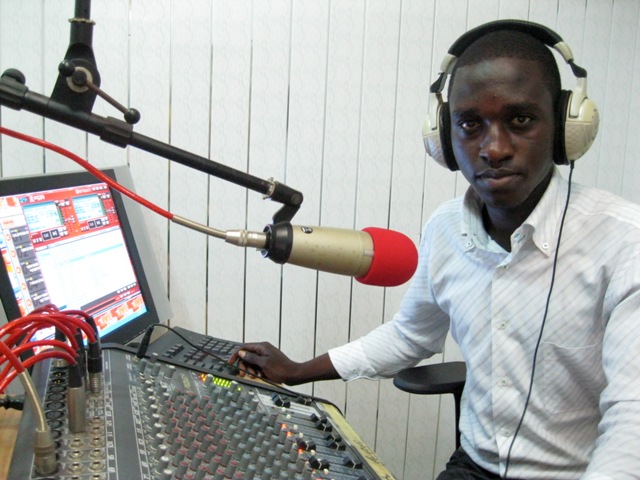
Mr. Roland, a.k.a. Asaasewura Santana.

You hear it everywhere, in taxis, pumping out of spot bars and echoing through the streets: “Li-i-i-ive ef e-e-em! 107.5 Live FM. Your number one radio station.” In fact, the ubiquitous two-month-old radio station is dedicated to “Shaping the Coast.”

Although Cape Coast already has five other radio stations, Live FM promises a fresh alternative to its regional competitors.

“We are setting a standard,” said Gilbert Anaane Roland, a host for Live FM. “We have come to give [Cape Coast] quality entertainment.”

Although Live FM has succeeded in infiltrating Cape Coast’s radio frequencies, the real test will arrive when the station launches its regular programming. On March 1, Live FM will begin testing its “Drive Time” show, Akwaaba, hosted by Mr. Roland, a.k.a. Asaasewura Santana.

“Drive Time is not about playing music dedications,” Mr. Roland said. “It’s a serious business that you bring total inspiration and motivation to the audience.”

The program will run between 2 p.m. and 6 p.m. when Mr. Roland believes the public needs inspiration the most.

“At 2:00 to 6:00, that is when people have the things they did in the markets they were not able to accomplish, so they need … something that can get them on to give them hope for the next day.” Mr. Roland said. “So, you give them entertainment—something that they can listen to and have fun with.”

The four-hour pilot show, Akwaaba, will begin with an inspirational segment, followed by interviews with entertainment personalities and phone-in discussions on topical issues to get listeners involved. Gospel music will play intermittently for the first two hours, followed by secular music for the second two hours.

Although Live FM is all about the music and entertainment now, the station plans to incorporate more news and educational programming as time goes on. Moreover, Live FM will collaborate with Okay FM in Accra to help out with the Cape Coast’s station’s news programming.

“Before the newspapers are available in the Central Region, the radio station in Accra will have already broadcast it,” Mr. Roland said. “We have competitors here [in Cape Coast] who are also picking from Accra, so by the time you get on the radio to put the headlines across, people have already heard them.”

According to Mr. Roland, Live FM will mix the Okay FM’s news with discussions of local issues and allow time for listeners to call in to voice their thoughts and opinions.

Despite the rumour mill, Live FM claims no affiliation with the NDC or any other political group.

“The perception out there is that when you are able to obtain your license in every administration, that means you have links [to the government],” Mr. Roland said. “We are neutral, and this will come across when we start our political programming.”

Apart from partnering with an Accra radio station for on-the-spot news broadcasting, most of Live FM’s DJs and hosts also come from outside the Central Region. Subsequently, 90 percent of Live FM programming will be conducted in Twi and 10 percent conducted in English. Nevertheless, Mr. Roland is optimistic communication between program hosts and the Cape Coast community will not be a problem.

“People who can speak Twi can understand Fante,” Mr. Roland said. “It’s just in general how you represent the message to the audience.”

Mr. Roland refers to Live FM’s special Valentine’s Day broadcast to prove his point. He said the response to the program was “massive” and listeners were apparently rallying for the show to continue past its schedule.

“What people want are catchy programs,” Mr. Roland said. “[Success] depends on the passion of the presenters on your radio and how they are able to get the issues across.”

The name, “Live,” supports the vibrant and active programming the station aims to convey. Live is of course the opposite of dead. Therefore, you can expect Live FM will not stand for stale or recycled programming. Instead, the station seeks to be the cutting edge not only for Cape Coast, but also for the Central Region and eventually all of Ghana.

Currently, Live FM is broadcast only in the Central Region, as well as some areas in the Western Region, but the station is looking to expand in the future. In addition, Live FM is working on its website to provide online radio service soon.

“We are not going to leave any stone unturned,” Mr. Roland said. “Five years from now, the sky won’t even be the limit for Live FM because there are footsteps on the moon.”

NHIS SHOULD COVER TRADITIONAL MEDICINE

Some of the patients who were cured of stroke
by Caroline Berg (Projects Abroad)

If 70 percent of Ghana’s population seeks traditional herbal remedies to cure its ailments, then why is traditional medicine not covered in the National Health Insurance Scheme?

“We are appealing to the medical personnel at the local hospitals to include traditional medicine in their services,” the Queen mother of Mankessim, Nana Amageduah I, said during a presentation at the Odo Pee Herbal Research and Learning Center in early February.

Over a dozen recovered stroke patients and a seven-man band came out to the research center to support and raise awareness of Ghana’s traditional medicine. The event also functioned as an appeal to the government to include traditional medicine in Ghana’s National Health Insurance Scheme. 

“[Orthodox] doctors know about traditional medicine, but they think it is inferior to their medicine,” said Bishop Okanto Davies, National Projects Coordinator for Health Education.

Nevertheless, interest in Ghana’s traditional medicine is growing steadily and people arrived from all over the country on Saturday to witness the healing power of the Odo Pee center’s alternative medicines.

Mr. John Kofi Sackey, CEO of the Odo Pee Herbal Research and Learning Center, led the presentation and invited each patient up to demonstrate his or her health. One woman ambled around the lawn with a cane, but then soon discarded the walking aid to march proudly on her own, which was met with great applause. 

“We want to make stroke hope for all those who are having stroke to be healed over here,” Mr. Kofi Sackey said, referring to the Odo Pee center.

Although the center has achieved great success in healing stroke victims of all ages, Mr. Kofi Sackey is calling on the government to come to the center’s aid. To better serve its clientele, the center needs more space, more beds and access to modern machines for further research into plant medicine and also for drug testing.

According to Mr. Kofi Sackey’s PR Officer, Mr. Samuel Sackey, the government had not responded to the center’s initial pleas for help.

“So, we took it upon ourselves that we will research herbal medicine,” Mr. Samuel Sackey said. 

After taking Odo Pee’s medicine to a scientific research center for standardization, it was approved for sale in the markets. Finally, Odo Pee’s products were certified by the government and will soon be used in hospitals alongside conventional drugs.

In general, proponents of traditional medicine are frustrated by the government’s lackadaisical response to the sector’s pleas for assistance. In Ghana, the ratio of traditional medicine practitioner to patient is 1:400, whereas the ratio of conventional doctor to patient is 1:20,000. 

One study conducted in the Sekyere South District of Ashanti revealed how patients must walk over 25 kilometers to access the nearest conventional health center. One subject voiced concern over the demands of such a trip, which could aggravate one’s illness and result in an unnecessary death. Subsequently, most people who live in Ghana’s rural regions seek traditional medicine practitioners in their own communities.

Besides proximity issues, the study found at least, 60 percent of Ghanaians also seek traditional medicine either because it is cheaper or they simply believe it to be more effective.

“I’ve witnessed so many traditional herbal clinics and I’ve seen that most of the herbs that are given in treatment to people sick with something serious like stroke, it is better that they use the traditional medicine,” Bishop Davies said.

Not only may traditional drug usage be more beneficial to the individual, but promoting and utilizing Ghana’s own rich stock of natural resources for medicinal purposes could also save the country millions of dollars on imported drugs. 

Moreover, annual global demand for traditional medicine is increasing exponentially and Ghana stands to benefit greatly in this sector. As is evident through China’s traditional medicine exports, which totaled in at 1.46 billion U.S. dollars in 2010, natural medicines are in high demand. 

Nevertheless, Ghana’s traditional medicine industry must tackle several significant issues before it may expect full government support and approval. The first key step for the industry is to organize a database of the country’s legitimate traditional medicine practitioners.

“We’re going to see that the policemen, who helped the Ghana Federation of Traditional Medicine Practitioners, see that all the quack practitioners are out of the system,” Mr. Kofi Sackey said.

Starting in February, Ghana’s National Coordinating and Monitoring Evaluation Offices will begin weeding out charlatan medicine vendors, which is not a simple task. According to Mr. Sackey, some drug vendors who sell their products from the trunks of their cars, although they may appear suspicious, are actually safe sources for traditional medicine.

The proposed registration will help facilitate the important integration of traditional and conventional medicine practices in the nation’s health delivery system to complement each other through cross referral of cases to produce a more effective overall health delivery service.

Registration will require practitioners to provide their personal data, educational backgrounds and professional experience. In addition, practitioners are advised to document their research and practices to prove the quality and safety of their products and services. 

Where conventional medicine excels, Ghana’s traditional medicine lags far behind. The traditional sector has yet to fully develop cogent methodologies to prove product efficacy and ensure product quality. It must also standardize manufacturing practices, consistently test for product safety and conduct post-marketing surveys to pinpoint any adverse results. 

Those present at the Odo Pee center, however, appear prepared to see this arduous battle through.

“When you go to China or other African countries, they use traditional medicines,” Bishop Davies said.    But, it’s not like that.”

AAK CITRUS FARMERS APPEAL FOR SUPPORT

by Caroline Berg (Projects Abroad)

Citrus Farmers
For citrus farmers in the Central Region’s Abura-Asebu-Kwamankese District, overabundance is not a gift, but a burden. Central Press reporters found a group of seven harvesters one Friday in February resting in the shade of their six-acre orchard, looking somewhat dispirited. All around them, copious amounts of oranges lay under each tree in various degrees of decay.

While the Central Region Development Commission (CEDECOM) boasts a large portfolio of social intervention and economic projects to help grow and enhance the Central Region, the citrus industry so far remains its own advocate.

“We have the product, but no producers,” said Anthony Sam, a Field Officer for Pinora Company LTD. “The fruit is going bad.”

Here in the Central Region, farmers are understaffed, underpaid and underrepresented. Moreover, market demand is sorely deficient.

Last year, a sack full of roughly 100 oranges sold for GH¢4 each. When the farmers asked for GH¢8 per sack, their buyers would not budge. In the end, the farmers received GH¢4.20 per sack.  The extra GH¢0.20 go to the hired hands who assist in loading and transporting the oranges.

“We want the Ministry of Food and Agriculture to at least collaborate with us,” said Kojo Prah, a farmer in the Abura-Asebu-Kwamankese District. “At the moment, we do not receive any support from the government.”

Some farmers at their farm
According to Mr. Prah, the citrus in the orchard is going bad because he and his colleagues have no access to modern farming technology, including tractors to quicken the harvesting pace and pesticides to protect the citrus from rampant disease.

Obviously, no one wants to buy rotten or diseased fruit. Thus, productivity and buyer demand go hand in hand. Only when the farmers can produce a more desirable product may they expect incomes to better suit their hard work.

Another factor that is killing the citrus industry is the state of local processing plants. One citrus factory in the area has been defunct for decades and is now used as a private school, while another factory has been shut down for months due to malfunctioning machinery.

Consequently, Mr. Prah and his fellow farmers are calling on the government to make the citrus industry more attractive to investors.

“I would say to CEDECOM, they should help us,” Mr. Sam said, in accord with Mr. Prah’s grievances. “The farmers in the Central Region are really, really suffering.”

According to Mr. Sam, a working factory in the region could easily employ 200 to 300 people. With such a potentially fruitful citrus industry and ready workforce, how is it the government continues to ignore this agricultural sector?

Due to lack of support, increasingly more citrus farmers are abandoning the trade and cutting down their citrus trees. Even Mr. Sam is an example of the Central Region’s job bleeding in the agricultural sector. The young field officer is from the region and studied agriculture mechanics; however, he works out of the Eastern Region.

What the industry needs is better management. In November last year, the Cape Coast Farmers Cooperative Society Limited (CCFCSL) officially appealed to the government to establish some form of policy framework to actively help develop and promote citrus farming. Citrus farming is one of the largest fruit industries in Ghana with over 10,000 farmers across the country.

The creation of a Marketing Board would improve the standard of living for farmers, generate employment, boost local economies and alleviate poverty in the Central Region. In addition, the board would strengthen farmers’ negotiating powers and also assist in the production, harvesting, packaging, processing and marketing of all citrus varieties in the region.

“As for now, we farmers have no choice but to continue doing our job the way things are,” Mr. Prah said, “which is not providing us with positive results.”